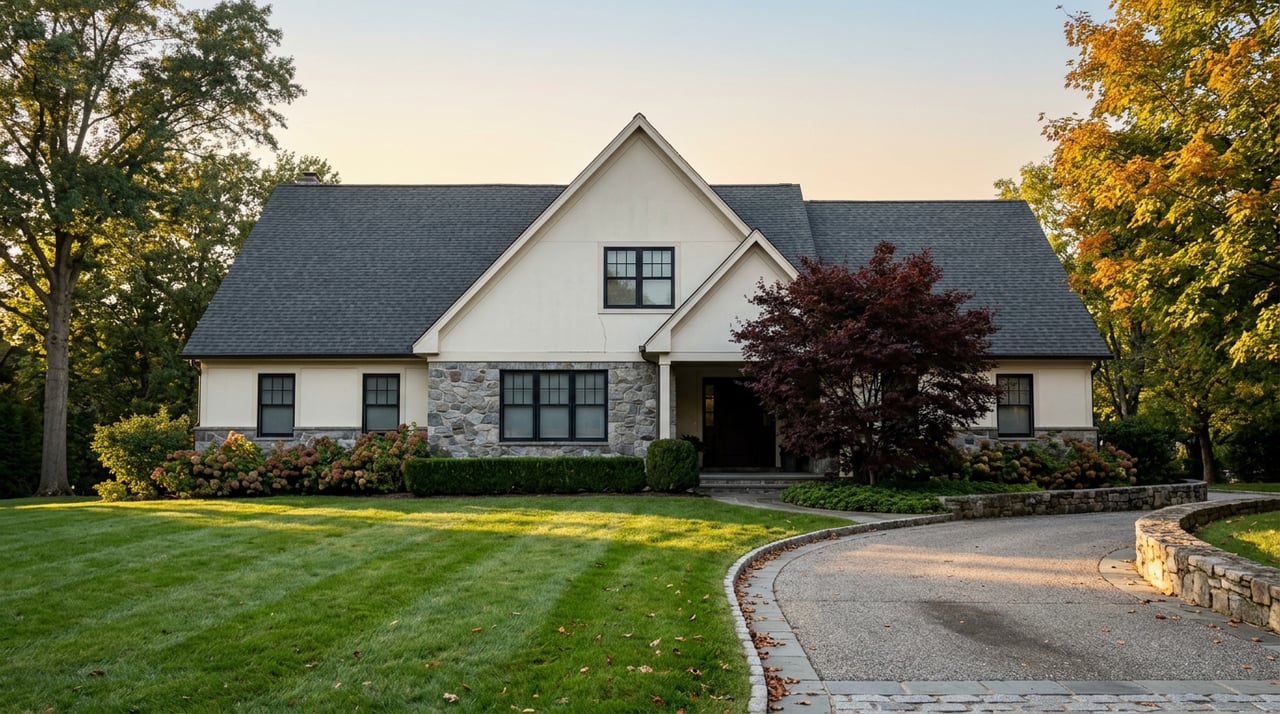
Pricing an Alpine Estate When the Comps Don't Exist
A homeowner in Alpine calls their bank to refinance, or lists their house, and the appraiser asks a routine question: what sold nearby in the last six months? In most of Bergen County, that question has an easy answer. In Alpine, it often doesn't. Bergen County's own Q1 2026 tracking showed just 2 year-to-date single-family sales in the borough against 21 active listings, with a year-to-date median price of $4.499 million and homes sitting an average of 38 days before going under contract. For comparison, Bergen County as a whole posted a year-to-date single-family median of $800,000 over the same stretch. Alpine isn't a smaller version of the county market. It's a different market wearing the same zip code.
That gap is the reason pricing an Alpine estate takes a different kind of work than pricing a home almost anywhere else nearby, and it's the reason sellers who assume their last appraisal experience will repeat itself are usually surprised by what happens next.
A standard residential appraisal leans on recent, comparable closed sales, typically three to six, within a tight radius and a recent window. That model assumes a functioning flow of transactions to draw from. Alpine's flow is a trickle. With two closed sales recorded year to date against a much larger pool of active listings, an appraiser working a file in Alpine frequently has to widen the search, stretch the time window, or pull from adjacent estate towns just to build a defensible comp set. Every one of those adjustments is a judgment call, and judgment calls are exactly where a bank appraisal and a seller's expectation can diverge.
| Metric | Alpine (YTD through March 2026) | Bergen County overall (YTD through March 2026) |
|---|---|---|
| Active single-family listings | 21 | County-wide inventory, far larger base |
| Year-to-date closed sales | 2 | Thousands |
| Year-to-date median sale price | $4.499 million | $800,000 |
| Average days on market | 38 | Varies by town |
The practical consequence is that a seller in Alpine should expect the appraisal conversation to start earlier and go deeper than it would in a higher-volume town. If a lender's appraiser can't find enough true comps, the number they land on may not match what the market has actually shown it will pay for a specific estate.
In a thin market like this, appraisers and experienced local agents lean on a different set of inputs to support a number, and each one tells you something concrete about how value gets built here.
Land carries its own price, separate from the house on it. A 2.55-acre vacant parcel on Route 9W sold for $1.45 million in April 2025, with nothing on the lot at all. That figure matters because it establishes a floor for what buildable acreage in Alpine is worth on its own, before a single stone or beam gets added. For a seller weighing a teardown-and-rebuild strategy, or for anyone trying to understand why two homes with similar square footage can carry very different price tags, that land-only sale is a useful anchor.
Replacement cost also plays a larger role than it would in a typical suburban appraisal. Because so many Alpine homes are custom builds with bespoke finishes, an appraiser often has to price out what it would cost to reconstruct the specific features in front of them rather than relying purely on what a similar-looking house sold for down the street, because there usually isn't a similar-looking house that sold down the street recently.
Privacy and view carry a premium that has to be estimated rather than pulled from a spreadsheet. Academic hedonic pricing research has documented measurable price effects for gated access and strong views, and that pattern shows up on the ground in Alpine, where setbacks, mature tree cover, and orientation toward the Hudson or the Manhattan skyline can separate two otherwise comparable estates by a meaningful margin. An appraiser has to make a judgment about how much of that premium applies to the specific property in front of them, and that judgment is where a conservative appraisal and an accurate one can pull apart.
Anyone pricing an Alpine estate should look at two very different numbers before setting expectations. Automated valuation tools, which estimate value from public records and algorithmic modeling rather than recent closings, placed Alpine's average home value in the $3.05 million to $3.2 million range as of the first half of 2026. Closed-sale data for the same period told a different story, with a median sale price around $4.0 million and a median sale price of $745 per square foot.
That's not noise. It's a structural feature of a market this thin. Automated models are built to smooth over sparse data, which means they tend to understate a market where a handful of trophy closings pull the real median well above the algorithmic estimate. A seller who checks an automated estimate and prices to it, without adjusting for what actual closings have shown, can leave a meaningful amount of value on the table before the home even hits the market.
The negotiation dynamic in Alpine has also shifted in a direction worth knowing before you set an asking price. Multi-year NJMLS statistics for the borough show the sale-to-original-list-price ratio reaching 97.10 percent in 2025, the strongest showing in a ten-year data set that includes years where average days on market ran as high as 213. Sellers a few years ago could build in more room between an ambitious ask and a realistic close. That room has narrowed.
At the very top of the market, the ceiling itself has been reset. A sale at 48 Rio Vista Drive closed at $17.7 million, recognized as the highest-priced residential sale recorded on the New Jersey Multiple Listing Service in both 2024 and 2025. That transaction sets a real, documented reference point for what the market will support at the trophy end, which matters when a seller and their agent are deciding how aggressively to position a truly exceptional property.
One more figure catches sellers and buyers off guard at the closing table. Alpine's 2025 effective property tax rate was 0.794, according to New Jersey Division of Taxation figures, which is lower than several nearby Bergen County luxury towns, including Saddle River at 1.030, Franklin Lakes at 1.400, Englewood Cliffs at 0.995, and Ridgewood at 1.944. A lower rate sounds like a lower bill. On an assessment in the multi-million-dollar range, it isn't. The math that matters is rate multiplied by assessed value, and Alpine's assessed values are high enough that the absolute dollar figure still lands well above what a lower-priced town with a higher rate would produce.
For anyone weighing a purchase or planning around a post-sale reassessment, New Jersey's appeal window is worth knowing ahead of time. Petitions to the county board are generally due by April 1, or May 1 following a municipal revaluation or reassessment, and properties assessed above $1 million can appeal directly to the state Tax Court. Building that calendar into a transaction plan, rather than discovering it after a bill arrives, is part of pricing an Alpine sale correctly.
Will my Alpine appraisal look like the one I got on my last home? Probably not. With so few closed sales to draw from, the appraiser is more likely to widen the geographic or time window, lean on replacement cost, or make individual adjustments for privacy and view. Expect more explanation behind the number, not less.
What happens if a bank's appraisal comes in below the agreed price? This is a live risk in a thin-comp market. Sellers and their agents benefit from assembling their own supporting data, including recent land sales and documented top-tier closings, before the appraisal is ordered, so there is a case to make if the number comes in light.
Should I expect a tax reassessment after I sell? A sale can prompt scrutiny of the prior assessment, particularly on properties well above the borough's typical range. Knowing the April 1 and May 1 appeal deadlines in advance gives a seller or new owner time to act rather than react.
Pricing a home in a market this thin isn't a matter of pulling three comps and adjusting for square footage. It's a matter of knowing which inputs actually hold weight when the traditional ones run out, and knowing where the market has actually landed, not where an algorithm thinks it should. If you're weighing a sale or a purchase in Alpine and want a pricing strategy built on the borough's real transaction history rather than a generic estimate, The Klipper Group can walk through what your specific property would need to show to support its number, and what a custom market plan looks like from here.
Stay up to date on the latest real estate trends.
Start your journey towards your dream home today! Subscribe now for exclusive access to expert insights, insider tips, and the latest property listings. Don't miss out on the opportunity to make informed real estate decisions. Subscribe to our newsletter now!