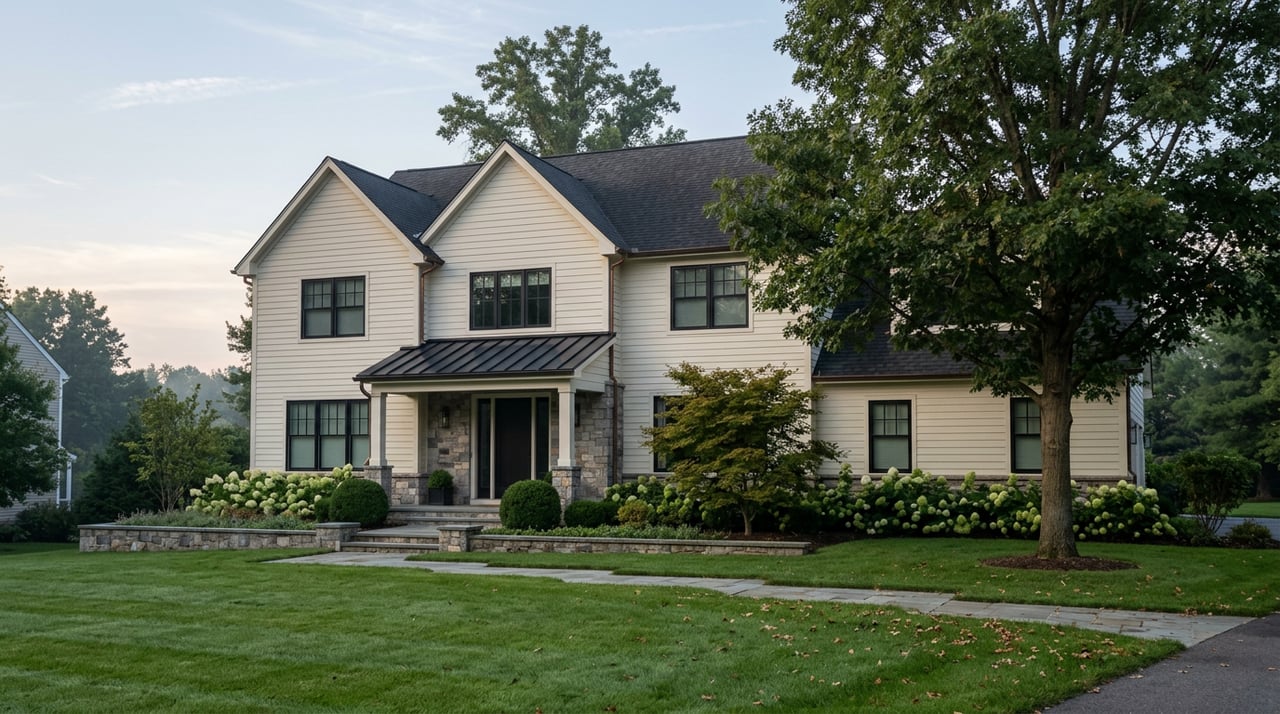
In Ridgewood, the Oil Tank Isn't the Problem. The Timing Is.
A tank sweep on an older Ridgewood property usually goes the way these things go: a technician walks the yard with a metal detector, gets a hit near the driveway or a rear corner where a fill pipe used to be, and everyone stops to figure out what happens next. If that moment happens during a routine pre-listing check, it's a phone call and a scheduling conversation. If it happens during attorney review, with a mortgage commitment already in motion and a closing date printed on a calendar, it becomes something else entirely: a negotiation the seller didn't choose to have, at a moment they don't control.
That difference, not the tank itself, is what actually determines how a Ridgewood sale goes when an underground oil tank enters the picture.
Ridgewood's median home was built in 1950, with close to 38 percent of the village's houses going up before 1940 and another slice arriving by decade's end. Separate housing-age data compiled by NeighborhoodScout puts nearly half the housing stock, 47.91 percent, in the 1940s-through-1960s window, the postwar wave of Capes, Colonials, and Ranches built for returning GIs and young families. Add it up and the majority of homes in the village predate the point at which natural gas heat became the default choice in this part of Bergen County.
That matters because homes of that era were built to burn heating oil, and the oil came from a tank. Sometimes it sat in the basement. More often it went into the ground, a pattern that shows up across the village's older residential pockets, including the Heights, the section of homes built between West Ridgewood and West Glen avenues from the 1890s through 1930.
Not every tank stayed there through a proper, permitted removal. Some were pumped out and abandoned in place when the furnace converted to gas. Some changed hands two or three times with each new owner assuming the last one dealt with it. The honest answer for a lot of older Ridgewood homes isn't "no tank" or "tank removed." It's "unknown," which is its own category of risk once a sale is underway.
Here's the part that surprises sellers: fixing the actual problem rarely costs much. A tank sweep, using magnetic locators or ground-penetrating radar to confirm whether something metallic sits beneath a yard or driveway, typically runs a few hundred dollars. If a tank turns up and comes out clean, with no leak and no contamination, contractors publishing New Jersey pricing this year quote roughly $1,500 to $3,500 for a standard underground removal, permits and backfill included. Tanks sitting under a basement slab run higher, often $2,500 to $5,000, because of the access work involved.
Contamination changes the math. If soil testing turns up petroleum hydrocarbons, remediation costs commonly start around $5,000 and climb from there depending on how much soil is affected and whether groundwater is involved, with severe cases reaching well into five figures.
Those numbers, on their own, don't explain why oil tanks have a reputation for derailing deals. Against a Ridgewood sale price, even $30,000 in worst-case remediation is a negotiating line item, not a dealbreaker. What actually stops closings isn't the dollar figure. It's who controls the process when the number gets decided.
Here's the mechanism that matters. Most conventional lenders will not fund a purchase with a known, undocumented underground tank sitting on the property, and FHA financing goes further, requiring the issue resolved before closing rather than escrowed or negotiated around it.
A tank discovered during a live transaction doesn't just cost money. It hands the buyer the negotiating leverage, the timeline pressure, and often the contractor selection, all at once.
That's the actual failure mode. A buyer's inspector finds a tank during the due-diligence window. The buyer's attorney flags it to the seller's attorney. Now there's a financing contingency at risk, a closing date that may not hold, and a seller who suddenly needs to move fast on a problem they didn't know they had. Buyers understand this leverage, and it shows up in how the cost gets negotiated. It's common for buyers to ask for a credit that runs higher than the contractor's actual quote, simply because the seller is now negotiating against a clock rather than a market.
Compare that to a seller who orders the sweep before listing, gets a clean report or handles the removal on their own schedule with a contractor they picked, and lists the home with documentation already in hand. Same tank, same soil, completely different negotiation.
| Handled before listing | Discovered during attorney review | |
|---|---|---|
| Who picks the contractor | Seller | Often dictated by buyer's timeline |
| Typical cost if clean | $1,500 to $3,500 removal | Same removal cost, plus a credit buyers may price above actual cost |
| Typical cost if contaminated | $5,000+, seller controls pace of remediation | $5,000+, under closing-date pressure |
| Effect on financing | None, documentation already exists | Can stall or kill FHA and conventional loans until resolved |
| Negotiating leverage | Stays with seller | Shifts to buyer |
New Jersey does run a reimbursement option for exactly this situation. The state's Petroleum Underground Storage Tank Remediation, Upgrade and Closure Fund offers grants and loans toward tank removal and cleanup costs. It's a real program, and it has helped a lot of homeowners recover money they spent on remediation.
It is not, however, something a seller can lean on during a pending sale. The fund reviews applications on its own schedule, and that schedule currently runs to several years, not weeks. That timeline works fine for a homeowner who already paid out of pocket and is applying for reimbursement after the fact. It does nothing for a seller trying to close a sale in the next sixty days. Anyone hoping to point a nervous buyer's attorney toward a pending grant application as a solution should understand that the fund is a subsidy for money already spent, not a bridge for money still owed.
For a house built before roughly 1970, and that describes most of the village, it's worth doing this before a buyer's inspector does it first:
Does New Jersey law require removing an underground oil tank before selling? No. There's no statute that mandates removal simply because a home is changing hands. What the law requires is disclosure of a known tank on the seller's property condition statement. In practice, buyers, lenders, and title companies routinely require documentation, removal, or an escrow before they'll close, so the requirement tends to arrive through the deal rather than through the law itself.
Who pays for it, buyer or seller? It's negotiable, but the cost most often falls to the seller, either through removal before listing or a credit at closing.
What if I genuinely don't know whether my house has one? Check for the physical signs first, an exterior fill pipe, an odd patch in the driveway, and pull whatever permit history the municipality has on file. If there's no documentation either way, a sweep before listing is a small cost against the alternative of finding out during attorney review.
Older Ridgewood homes carry real character, and most of them carry this question too, whether anyone's asked it yet or not. Getting the answer before a buyer's attorney does is the difference between a line item and a leverage problem.
If you're weighing whether to get ahead of this before listing an older Ridgewood home, The Klipper Group can walk through what your specific property's history shows and put together a plan that keeps the timeline, and the negotiation, in your hands. Reach out to Roi or the team for a custom market plan or a property-specific valuation.
Stay up to date on the latest real estate trends.








Start your journey towards your dream home today! Subscribe now for exclusive access to expert insights, insider tips, and the latest property listings. Don't miss out on the opportunity to make informed real estate decisions. Subscribe to our newsletter now!